
Stock market investing can seem confusing when you are just getting started. You may have questions about how stocks work, how much risk is involved, and what you should learn before investing your money.
The good news is that you don’t need to understand everything at once. A better starting point is to learn the basics, understand how companies and markets work, and gradually build your knowledge.
In this guide, we’ll cover the fundamentals of stock market investing, the difference between investing and trading, how compounding works, what to look at when studying a company, common mistakes beginners make, and the risks you should understand before making investment decisions.

- What Is Stock Market Investing?
- Why Do People Invest in Stocks?
- Understanding the Fear of Investing
- The Power of Compounding in Stock Market Investing for Beginners
- How to Study a Company Before Investing
- 3. Understand Debt
- Stocks vs Bank Savings: Understanding the Difference
- Managing Emotions While Investing
- Think About Your Long-Term Goals
- Frequently Asked Questions
- What Should You Learn Next?
What Is Stock Market Investing?
Stock market investing means buying shares of publicly listed companies and becoming a part-owner of those businesses. As a shareholder, you may benefit if the value of your investment increases or if the company distributes dividends. However, stock prices can also fall, and returns are not guaranteed.
Why Do People Invest in Stocks?
- To participate in the growth of businesses
- To potentially grow wealth over the long term
- To build investments beyond traditional savings
- To work toward long-term financial goals
Every investor starts with a different amount of money, knowledge and experience. What matters for a beginner is understanding the basics before making investment decisions.
Understanding the Fear of Investing
It is normal for beginners to worry about losing money in the stock market. Prices can move up and down, sometimes sharply, and no investment comes without risk.
Instead of letting fear or excitement drive decisions, beginners can focus on learning how the market works, understanding the risks and developing a clear approach to research.
How Can Beginners Manage This Fear?
- Start by learning, rather than rushing to invest.
- Understand that stock prices can fall as well as rise.
- Learn from books, online resources, or mentors.
- Avoid investing money you may need in the short term.
- Learn from reliable books, financial education resources and company reports.
- Give yourself time to understand the market.
Every successful investor started somewhere. The key is to take that first step, no matter how small. The fear will fade with experience.
The Power of Compounding in Stock Market Investing for Beginners
Albert Einstein once said, “Compounding is the eighth wonder of the world.” It’s like planting a mango tree. At first, it’s just a small sapling, but with time and care, it grows into a strong tree that bears fruit every season without extra effort. Similarly, your investments, when left to grow, can multiply over time.
Compounding Example: For a simple illustration, suppose ₹10,000 grows at a constant 10% annual rate for 20 years, with no additional investment.
- Year 1:
- Investment: ₹10,000
- Annual return (10% of ₹10,000): ₹1,000
- Total value at the end of Year 1: ₹11,000
- Year 2:
- Investment: ₹11,000
- Annual return (10% of ₹11,000): ₹1,100
- Total value at the end of Year 2: ₹12,100
- Year 3:
- Investment: ₹12,100
- Annual return (10% of ₹12,100): ₹1,210
- Total value at the end of Year 3: ₹13,310
Now, let’s look at the impact of compounding over 20 years:
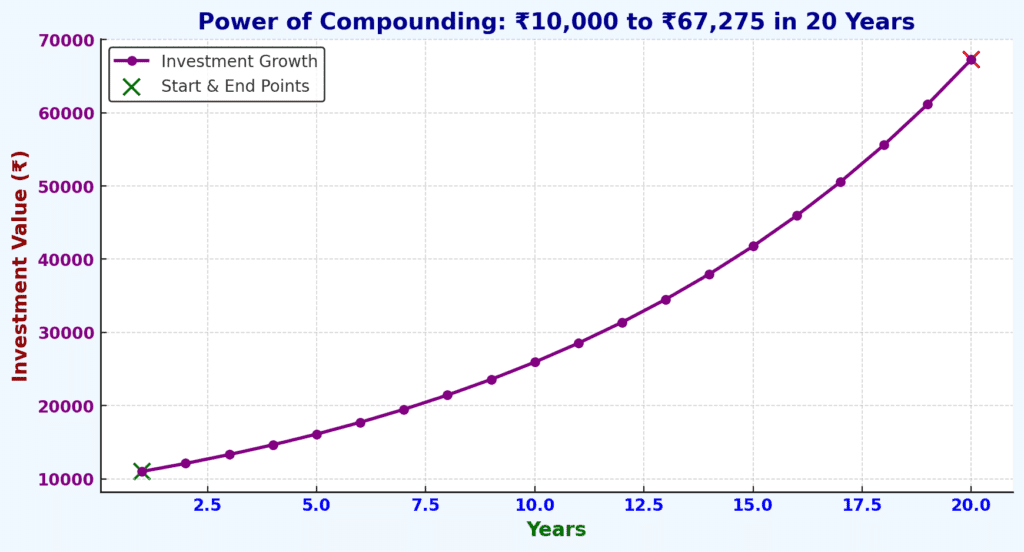
After 20 Years:
If you left your ₹10,000 investment to grow at a 10% return rate annually, it would grow to:
- Future Value = ₹10,000 × (1 + 0.10)^20
- Future Value = ₹10,000 × 6.7275
- Future Value = ₹67,275
Summary of the Example:
- Initial Investment: ₹10,000
- Annual Return: 10%
- Investment Duration: 20 years
- Final Amount: ₹67,275
Note: This is a hypothetical example to explain compounding. Actual stock market returns are not fixed and may vary significantly from year to year, including negative returns.
In this example, the power of compounding helps your ₹10,000 grow six times over in 20 years without you adding any extra money! The returns earned in one period can become part of the investment base for future growth.
How to Study a Company Before Investing
Picking the right stocks is like planting the right seeds in a garden. Some will bloom beautifully, while others may not. That’s why it’s crucial to make informed decisions.
1. Understand the Business
What does the company sell, and how does it make money?
2. Look at Financial Performance
Study revenue, profit, margins and cash flow over time.
3. Understand Debt
Check how much debt the company carries and whether it appears manageable relative to the business.
4. Consider the Industry
Understand the industry, competition and factors that can affect the company’s future.
5. Look at Valuation
A good company does not automatically mean its stock is attractively priced. Valuation matters too.
6. Understand the Risks
Consider business, industry, financial and market risks before reaching any conclusion.
7. Diversification
Avoid putting all your investment money into a single stock or sector.
Stocks vs Bank Savings: Understanding the Difference

Many people still park their savings in banks, earning minimal interest. While saving is important, investing in the stock market lets your money grow faster.
| Factor | Stock Market | Bank Savings |
| Price fluctuation | Generally low | Can be significant |
| Potential return | Generally lower | Higher potential, but uncertain |
| Risk to invested value | Generally lower | Higher |
| Liquidity | Generally high | Generally high for actively traded listed stocks |
| Return guarantee | Depends on account/product | No |
| Purpose | Short-term needs and cash reserves | Long-term wealth-building can be one purpose |
You should make your money work for you, not just let it sit idle in a savings account.
Managing Emotions While Investing
Stock prices can move sharply because of news, expectations, economic conditions and investor sentiment. Seeing an investment fall can create fear, while a rapidly rising stock can create excitement and FOMO.
Common emotional mistakes include:
- Panic selling
- Buying because others are buying
- Chasing rapidly rising stocks
- Checking prices constantly
- Making decisions without research
Learning to recognize these emotions is an important part of becoming a more disciplined investor.Patience and resilience are key to being a successful investor. When the going gets tough, remember why you started and stay focused on the long-term goal.
Think About Your Long-Term Goals
Investing should be connected to a financial goal and a time horizon. Your goals, risk tolerance and financial situation can influence how you approach investing.
Then:
Avoid making decisions based only on short-term market movements.Your journey in the stock market can change your life. The sooner you begin, the closer you get to financial independence. It’s never too late to start!
Learn before investing.
Understand the risks.
Diversify where appropriate.
Review your understanding as you gain experience.
Frequently Asked Questions
What is stock market investing for beginners?
Stock market investing means buying shares of publicly listed companies and becoming a part-owner of those businesses. Investors may benefit when the value of their shares increases or when a company pays dividends. However, stock prices can also fall, so investing in stocks always involves some level of risk.
How much money does a beginner need to start investing?
There is no fixed amount that every beginner needs to start investing. The amount depends on your financial situation, goals and the type of investment you choose. Instead of focusing only on how much to invest, beginners should first understand the basics of the stock market, risk and diversification.
Is stock market investing risky?
Yes, stock market investing involves risk. Share prices can rise or fall because of company performance, economic conditions, market sentiment and other factors. You can reduce some risks through research and diversification, but there is no way to completely eliminate investment risk.
How to Analyse Stocks for Long-Term Investment?
To analyse a stock for long-term investment, start by understanding the company and how its business makes money. Look at its revenue, profit, cash flow and debt to get a basic idea of its financial health. It is also useful to understand the company’s industry, competitors and competitive position.
Next, consider whether the stock’s current valuation appears reasonable compared with the company’s financial performance and future prospects. You should also understand the major risks that could affect the business.
A simple checklist is to ask: Do I understand the business? Is the company financially healthy? How are its revenue and profits performing? Does it have manageable debt? What are its major risks? Is the current valuation reasonable?
No single number or ratio can tell you whether a stock is a good long-term investment. A better approach is to study the overall business, financial performance, valuation and risks before making an investment decision.
What is the difference between investing and trading?
Investing generally focuses on holding stocks or other investments for a longer period while considering the underlying business and its future potential. Trading usually involves buying and selling more frequently to take advantage of shorter-term price movements. Both approaches involve risk, but the time horizon, decision-making process and skills involved can be different.
What Should You Learn Next?
Stock market investing is easier to understand when you build your knowledge step by step. Start with the basics, then learn how to study companies, understand financial statements, manage risk and recognize common investing mistakes.

Disclaimer: The information provided in this article is for educational purposes only and should not be considered as financial advice. Always conduct your own research or consult with a qualified financial advisor before making any investment decisions.