
Gold and silver have always attracted investors looking for diversification, protection against economic uncertainty, and long-term wealth preservation. But in 2026, the question is becoming more important: Gold vs Silver which precious metal is better for investment?
Both metals have delivered strong moves in recent years, but they play different roles in an investment portfolio. Gold is generally viewed as a defensive asset and a store of value, while silver has greater exposure to industrial demand and tends to be more volatile.
Recent market developments have once again brought precious metals into focus. Gold has recovered from its sharp correction earlier in 2026, while silver continues to attract attention because of its industrial uses and higher price volatility.
So, should investors choose gold, silver, or both?
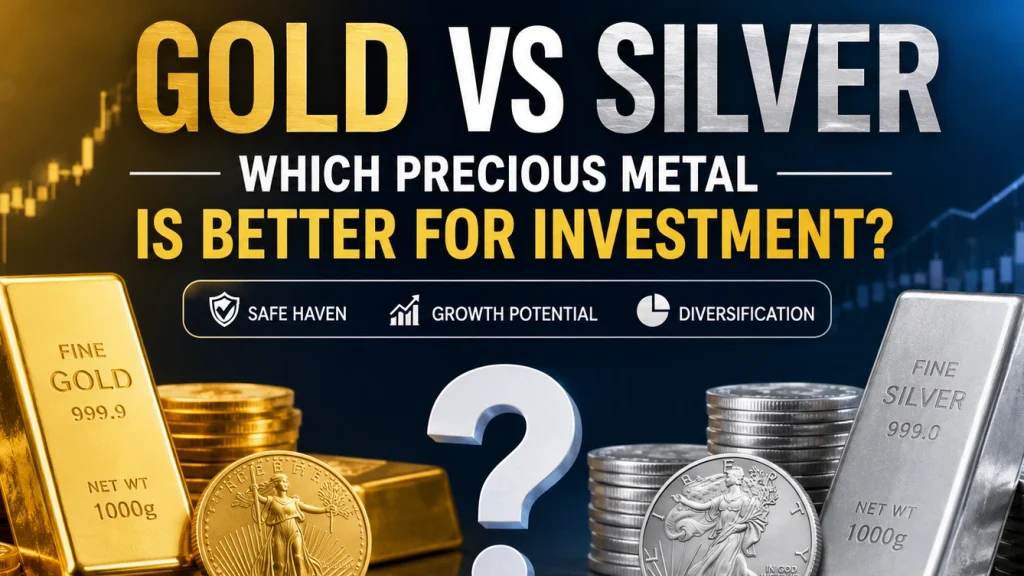
Gold vs Silver: What Is the Difference?
Although both are precious metals, gold and silver behave differently in the market.
Gold is primarily considered a store of value and a safe haven asset. Investors often turn toward gold when there is uncertainty around inflation, currencies, interest rates, geopolitical risks, or financial markets.
Silver, on the other hand, has both investment and industrial demand. It is used in areas such as solar technology, electronics and other industrial applications. This gives silver an additional source of demand that gold does not have to the same extent.
This difference is important because it can make silver’s price movements much sharper than gold’s.
Why Gold Remains Important in 2026
Gold has experienced significant volatility in 2026. After reaching record levels earlier in the year, prices went through a major correction before recovering again. Reuters reported that gold rebounded strongly in August as investors regained interest in its safe-haven characteristics.
Several factors continue to influence gold:
- Global economic uncertainty
- Interest-rate expectations
- US dollar movements
- Inflation expectations
- Central-bank demand
- Geopolitical tensions
- Investor demand for safe-haven assets
Gold’s biggest advantage is its defensive nature. During periods of uncertainty, investors often consider gold as a portfolio diversifier rather than simply a source of high returns. That makes gold particularly relevant for investors who prioritize stability.
You may also Like : Mutual Funds for Beginners: Start Smart with SIP 2026
Why Silver Is Getting More Attention
Silver has a different investment story.
Unlike gold, silver has significant industrial demand. It is used in manufacturing, electronics, solar technology and other applications. This means that silver can benefit when industrial activity and technological demand increase.
However, that additional demand also comes with additional volatility.
Silver can rise faster than gold during strong commodity cycles, but it can also fall more sharply when market sentiment changes.
That is why silver may offer greater upside potential, but investors need to be comfortable with higher price fluctuations.
Motilal Oswal also notes that silver has higher growth potential than gold but comes with higher risk because of its greater price volatility.
Gold vs Silver: Which Is More Volatile?
If your priority is lower volatility, gold generally has the advantage.
Silver’s market is smaller and more sensitive to industrial demand and investor sentiment. As a result, its price can move rapidly in either direction.
This creates an important distinction:
Gold = relatively defensive
Silver = relatively aggressive
Neither is automatically better. The right choice depends on the investor’s objective, time horizon and risk tolerance.
Gold vs Silver in 2026: Which Has More Potential?
It is difficult to predict the exact future price of either metal.
Gold’s outlook remains supported by its safe-haven role, central-bank demand and macroeconomic uncertainty. At the same time, silver has a potential advantage from industrial demand and supply-related factors.
The World Gold Council’s 2026 outlook highlights the unusual strength of gold’s start to the year and the importance of macroeconomic conditions in determining its future path.
For silver, supply conditions and industrial demand remain important factors. JPMorgan’s 2026 outlook also points to uncertainty around silver prices as market conditions evolve.
Therefore, instead of asking which metal will definitely rise more, investors should ask:
Which metal fits my investment objective better?
Should You Invest in Gold or Silver?
There is no universal answer.
Gold may suit you if:
- You want portfolio stability.
- You want exposure to a traditional safe-haven asset.
- You have a lower tolerance for volatility.
- You are investing for long-term diversification.
- You want precious metals primarily as a defensive allocation.
Silver may suit you if:
- You can tolerate higher volatility.
- You want greater exposure to industrial demand.
- You have a longer investment horizon.
- You are comfortable with larger price fluctuations.
- You want to complement gold with a higher-risk precious metal.
You may also Like : How to Create an Investment Plan in 5 Simple Steps
Should You Invest in Both Gold and Silver?
For many investors, the decision does not have to be Gold vs Silver.
It can be Gold + Silver.
Using both metals can provide different characteristics within the precious-metals portion of a portfolio.
Recent commentary from Tata Mutual Fund has favored gold as the core precious-metal allocation, with silver serving as a complementary allocation because of its industrial-demand potential. The fund has also emphasized staggered investment rather than chasing short-term price movements.
For example, an investor might choose a larger allocation to gold and a smaller allocation to silver rather than putting the entire precious-metals allocation into one metal.
The exact allocation, however, should depend on the investor’s overall portfolio and risk profile.
Gold vs Silver: Investment Options in India
Indian investors can get exposure to gold and silver in several ways.
1. Physical Gold and Silver
This includes jewellery, coins and bars.
The major disadvantage is that investors need to consider making charges, storage, purity and liquidity.
Jewellery is generally not the most efficient option if the primary objective is investment.
2. Gold and Silver ETFs
Exchange-traded funds can provide market-linked exposure without requiring investors to physically store the metal.
They can be useful for investors who want a more convenient investment structure.
3. Gold and Silver Mutual Fund Options
Investors can also access precious metals through certain mutual fund structures, depending on the available schemes and regulations.
These may be convenient for investors who prefer the mutual-fund route.
4. Digital Gold and Silver
Digital products may provide another way to obtain exposure to precious metals, but investors should carefully examine the provider, costs, ownership structure and regulatory framework before investing.
5. Futures and Commodity Trading
Gold and silver futures are available through commodity exchanges such as MCX.
However, futures are leveraged instruments and are very different from long-term investing. They may not be suitable for beginners because losses can increase quickly.
Is It a Good Time to Invest in Gold and Silver in 2026?
This is where investors need to be careful.
Strong recent price movements can create the temptation to buy after a rally. But chasing prices simply because an asset is rising can increase investment risk.
A staggered approach may help investors avoid putting all their money into the market at one price.
Instead of asking:
“Will gold or silver rise tomorrow?”
long-term investors should consider:
“How much precious-metal exposure makes sense for my overall portfolio?”
This change in mindset can help investors focus on asset allocation rather than short-term predictions.
Gold vs Silver: A Simple Comparison
| Factor | Gold | Silver |
| Main role | Store of value | Precious + industrial metal |
| Volatility | Generally lower | Generally higher |
| Safe-haven demand | Strong | Moderate |
| Industrial demand | Lower | High |
| Risk level | Relatively lower | Relatively higher |
| Growth potential | Moderate to high | Potentially higher |
| Suitable for | Defensive allocation | Higher-risk diversification |
What Should Long-Term Investors Do?
There is no need to treat gold and silver as competing investments.
Gold can provide the defensive foundation, while silver can add exposure to industrial growth and potentially higher returns—but with higher volatility.
The important point is allocation and discipline.
Investors should avoid making decisions solely because gold or silver has recently gone up. Precious metals can experience significant corrections even during a longer-term bullish cycle. A diversified portfolio should also not depend entirely on precious metals. Equities, fixed income, cash and other assets may play different roles depending on an investor’s goals and risk tolerance.
Final Thoughts
So, Gold vs Silver which is better in 2026?
The answer depends on what you want from your investment.
If your priority is stability, wealth preservation and protection during uncertain periods, gold may be the better fit.
If you are comfortable with higher volatility and want exposure to industrial demand and potentially greater upside, silver may be more attractive.
For investors who want exposure to both characteristics, combining gold and silver can be a more balanced approach than choosing only one.
The key lesson is simple:
Don’t invest in gold or silver simply because their prices are rising. Invest according to your financial goals, risk tolerance, time horizon and overall asset allocation.
Precious metals can have an important role in a diversified portfolio, but they should be treated as one part of a broader investment strategy not as a guaranteed path to returns.
Disclaimer: The information provided in this article is for educational purposes only and should not be considered as financial advice. Always conduct your own research or consult with a qualified financial advisor before making any investment decisions.